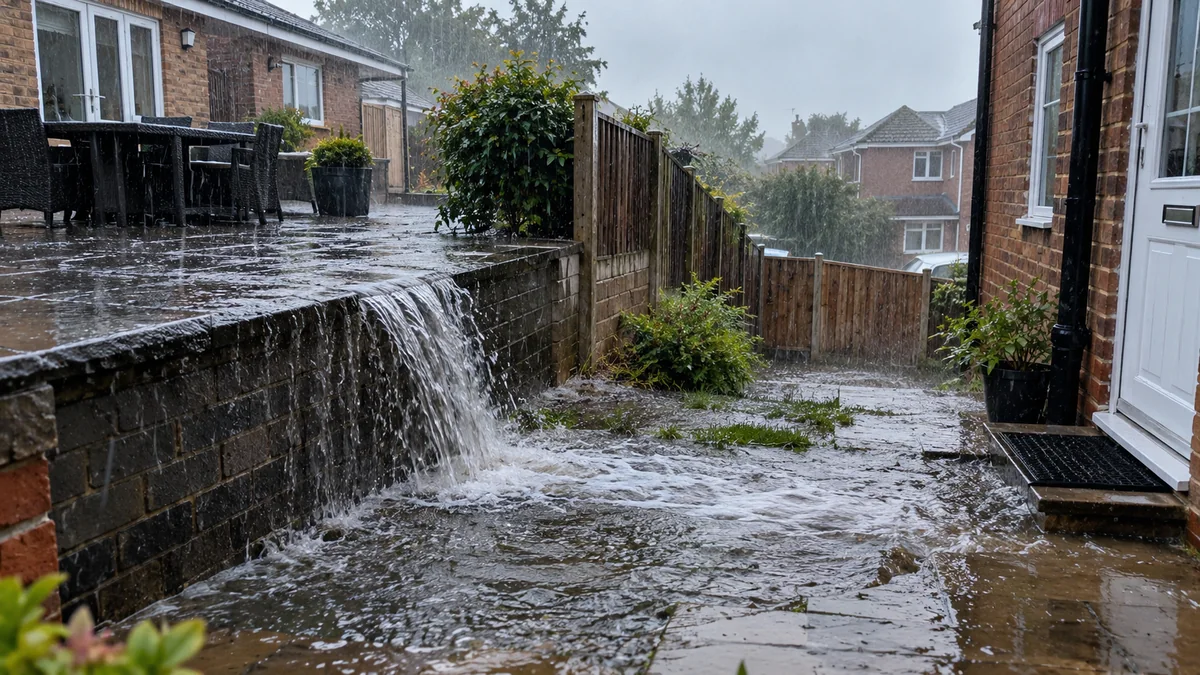
Record the route
Take photographs safely during rainfall, showing where water comes from and how it reaches your property. Note changes to adjoining paving, extensions or landscaping.
Natural runoff versus alterations
Water may naturally run downhill, but changed ground levels or new hard surfaces can alter the amount and direction. Legal responsibility is fact-specific and should not be assumed from a single photograph.
Check your own drainage too
If your gullies or outlets are blocked, they may worsen the effect of incoming runoff. Several problems can exist at the same time.
Avoid creating a new problem
Raising a wall, installing a barrier or digging a trench can divert water elsewhere. Discharge to a sewer or watercourse may require permission.
Try early communication
Sharing the photographs and asking how both properties can deal with runoff may be quicker than an argument. For persistent disputes, seek independent advice.
Useful professional help
A drainage or landscaping assessment can establish levels, flows and lawful disposal options. For rights and responsibilities, ask a solicitor rather than relying on a contractor to decide the law.
Record the actual route of runoff
Water from higher land naturally flows downhill, but changes to paving, extensions, raised beds or downpipe arrangements may concentrate it in a new place. Take photographs during rainfall where it is safe, showing the direction of flow and any recent building work. Distinguish water moving across land from a pipe or channel deliberately discharging over a boundary. Those situations may raise different practical and legal questions.
Find a solution that will not shift the problem again
Speak to the neighbour where possible and compare observations calmly. A drainage contractor may be able to assess levels, outlets and suitable interception, but any proposal needs to consider where the collected water will go. Simply building a wall or raising your own paving may move the flow into your house or someone else’s garden. If responsibility is disputed, obtain independent advice, retain evidence and avoid making expensive changes before the source has been established.
Record what actually crosses the boundary
After heavy rain, take photographs from your own property showing the direction of water and where it collects. Keep dates, approximate rainfall conditions and details of any recent landscaping. Water naturally follows levels; a neighbour may not have deliberately directed it towards you. On the other hand, a new patio, drain outlet or raised garden can change where runoff goes.
Do not enter neighbouring land to investigate or assume that the visible boundary fence marks the drainage divide. A level survey can be more helpful than an argument about where the puddle first appeared.
Distinguish surface runoff from a defective drain
If water appears only when the neighbour empties an appliance or where a pipe exits a wall, a drainage fault may be involved. A foul smell, discolouration or persistent flow in dry weather also warrants further investigation. Keep away from suspected sewage and ask the relevant water company or local authority for guidance where appropriate.
If the problem occurs during exceptional rain across a wider area, the answer may lie with local topography and the capacity of public drainage rather than a single neighbour’s action.
Why building a barrier can be the wrong first move
Raising a fence base or constructing a wall may hold water against your own building, or redirect a larger volume towards a third property. Water pressure and poorly drained retained soil can also damage a garden wall. Before making permanent changes, work out how water will leave the site once it has been intercepted.
A drainage channel can be effective in the right position, but only when it has a lawful, reliable outlet. A trench ending in saturated clay may do nothing except move the puddle.
Approach the neighbour with useful evidence
A practical conversation is often the best first step. Explain when the water arrives and share photographs or a simple plan. If recent works coincide with the problem, ask whether drainage details were agreed or installed. Where agreement proves difficult, independent survey advice may clarify cause before either party spends money.
Legal responsibility for flooding depends on the circumstances and the relevant law; ordinary downhill runoff is not automatically the same as a deliberate discharge. Citizens Advice or a solicitor can assist where a genuine dispute remains.
What to ask before commissioning work
A competent contractor should assess levels on both sides of the boundary where access is available, locate services and describe where the diverted water will finish up. Get any permissions and boundary agreements in writing. Ask whether the proposal changes the risk to your house, the neighbour or a shared access route.
Keep invoices, survey notes and photographs. They will be useful if the drainage is altered again or an insurance claim becomes necessary.
Reliable further information
For current warnings, official flood-risk maps and safety advice, use the relevant government service. This website cannot assess live conditions at your home.
Government flood guidance · National Flood Forum · Citizens Advice