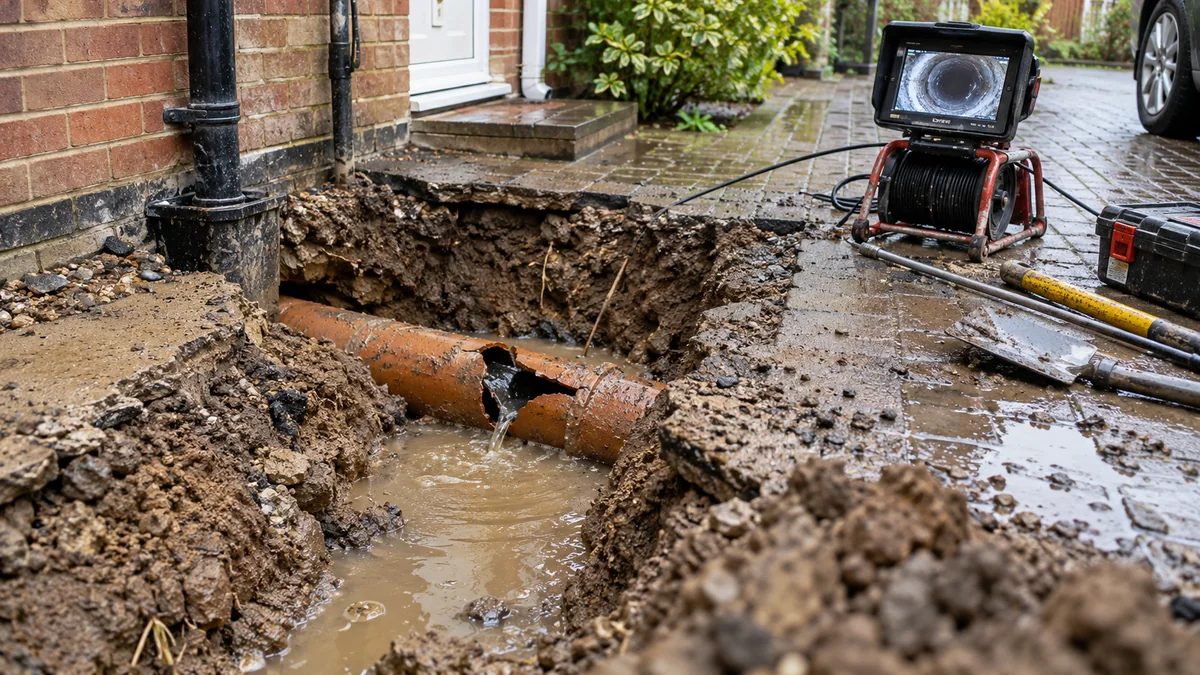
Look for clues before the excavation starts
Repeated local flooding, slow drainage, gullies that back up and patches of soft or sunken ground can all point towards a structural problem in the pipework rather than a simple blockage.
If the same stretch keeps causing trouble, it is worth asking whether the pipe itself has failed.
A drain can continue taking some water even after part of its wall has fractured. That makes the fault easy to overlook: toilets may still flush and a contractor may remove a blockage, yet heavy rain exposes the weakness. Record which appliances are affected and whether water rises in a gully, inspection chamber or toilet. If sewage is involved, avoid contact and keep children and pets away. Ground sinking beside a drain is another warning sign, although soft soil alone is not proof of a collapsed pipe.
Why a camera survey can matter
A drain camera survey may show whether the problem is roots, a displaced joint, a crack, a deformation or an actual collapse. That matters because the repair options are different.
Without that diagnosis, you risk paying for repeated clearance work when a structural repair is what the system actually needs.
Ask whether the camera survey includes a plan showing the position and depth of the defective section. The report should distinguish cracks from displaced joints and an actual collapsed bore; those descriptions are not interchangeable. A drain may also have several unrelated defects. Before accepting excavation, request the relevant images or footage and an explanation of why local repair or lining cannot provide a sound result. A post-repair camera check is useful evidence that the intended section has been repaired rather than merely cleared.
Responsibility is not always straightforward
Some drains are private and some sewers are the water company's responsibility. Which one you are dealing with may depend on the pipe's location and what it serves.
Before authorising major excavation, find out whether the damaged run belongs to you.
For England and Wales, the water company may be responsible for certain shared drains and lateral drains, although exceptions apply. Scotland and Northern Ireland have different arrangements. Check with the relevant sewerage provider before commissioning major works. Also tell your home insurer promptly if you suspect an insured drainage failure or associated subsidence. The order in which surveys, authorisations and excavations are undertaken can affect what evidence is available later, so keep copies of reports and photographs.
Excavation is not the only repair method
Some pipes can be locally repaired or relined. Others need excavation because the collapse is too severe or because the surrounding ground has also been affected.
A quotation should explain why a particular method is suitable rather than assuming digging is always necessary.
Check whether the surrounding ground has been undermined
A longstanding leak or washout can affect paving, driveways and sometimes the support to nearby structures. If the ground is visibly sinking or voiding, the repair may need to include reinstatement beyond the pipe itself.
That is one reason cheap drain clearance alone can become a false economy.
Compare quotations properly
Ask what evidence has been used, what length of drain is affected, whether reinstatement is included and how the repaired drain will be tested.
A cheaper figure may leave out camera work, reinstatement or the cause of the problem.
Distinguish a collapse from an ordinary blockage
Frequent blockages can arise from fat, roots or a poorly graded pipe as well as a structural break. A collapsed drain is a particular diagnosis, not a label for every stubborn obstruction. Ask the contractor to show the footage, identify the location and explain whether the pipe wall, a joint or the surrounding ground has actually failed.
Find out who is responsible before digging
In England and Wales, a sewer shared between properties is often the water company’s responsibility, though the details of the connection and location matter. Responsibility can differ elsewhere in the UK. Ask the relevant water or sewerage undertaker when ownership is uncertain. This may save you paying privately for work that should be investigated by someone else.
Consider the ground as well as the pipe
Escaping water can soften bedding or wash fine material out from beneath paving. If a path has sunk, a void has appeared or a nearby wall is moving, the repair needs to address the disturbed ground as well as the damaged pipe. Extensive excavation close to a shallow foundation needs competent planning; it is not simply a matter of opening a trench and dropping in replacement pipe.
Insist on a clear scope of reinstatement
The written proposal should state the pipe material, diameter, length being repaired, reason for choosing excavation or lining, testing method and how the garden, paving or driveway will be reinstated. If the survey identifies several defects, ask which ones are actually responsible for the current flooding and which can be monitored.
Official guidance and independent advice
Flooding can become dangerous quickly. Use official warnings and advice during an incident; this article is not a live risk assessment.
Prepare for flooding · Flood-proofing and recovery · National Flood Forum · Citizens Advice