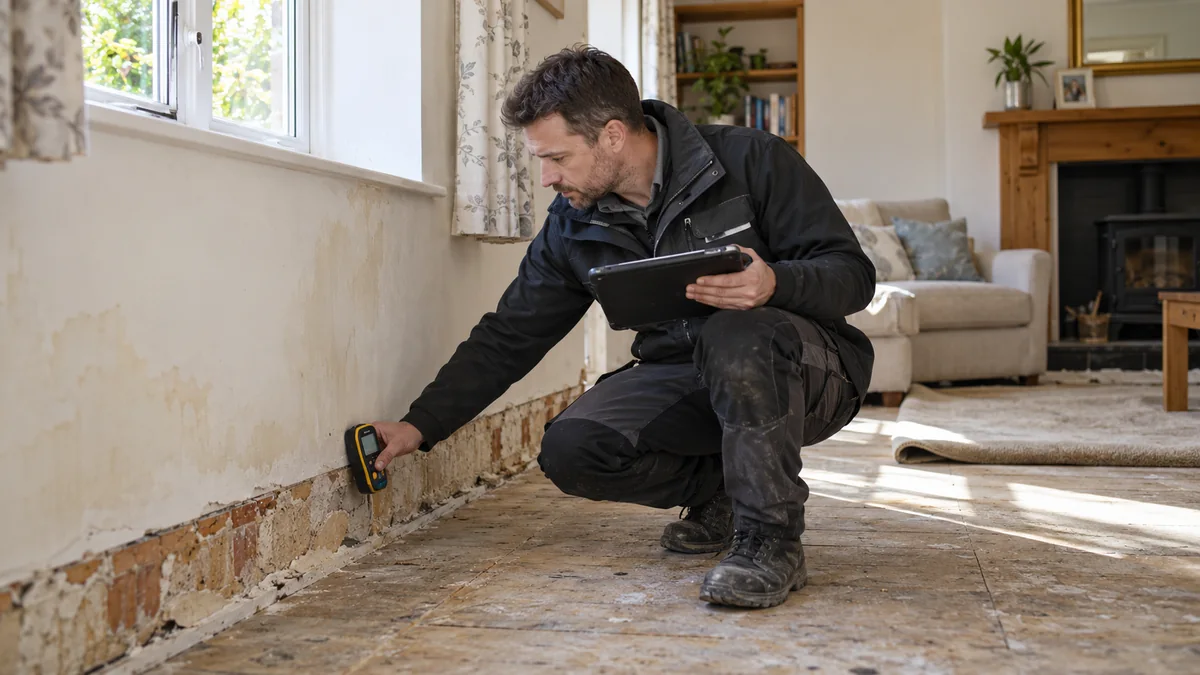
Why a survey comes before a quotation
A builder can price visible damage, but floodwater travels behind skirtings, into floor voids and beneath fitted units. Start with the source, depth and duration of flooding. Record whether the water might contain sewage, fuel or other contamination. A useful survey does not simply list rooms for redecoration: it explains what must be made safe, exposed, cleaned, dried and eventually reinstated.
An initial survey should not be confused with a quotation to redecorate. A useful report records the likely flood source, the areas reached, suspected contamination and the building elements that may remain wet. It should identify safety issues requiring specialist inspection, such as electrics and gas appliances, and say where further opening-up is needed. Photographs, simple plans and room-by-room notes are much more useful than a one-line statement that the house needs drying.
What to photograph and record
Photograph water marks, damaged fittings, floor coverings and the outside ground levels before they change. Keep dates of flooding, rainfall, drainage incidents and any emergency work. Photograph meter positions from a safe distance; never enter floodwater to reach them. This information can help a loss adjuster, surveyor and contractors understand the scale of the damage.
Ask the surveyor to separate visible damage from inferred hidden damage. A badly stained skirting board does not automatically mean the supporting wall has failed; similarly, a room that looks dry may conceal wet insulation or a saturated floor void. Where demolition is recommended, the report should explain what defect or contamination justifies it. If the assessment is being carried out by a firm hoping to secure the repair contract, it is sensible to ask how the scope has been independently checked.
Hidden spaces and structural concerns
Floor voids, insulation, suspended timber, wall linings and inaccessible corners deserve attention. Waterlogged insulation may remain wet well after the surface looks dry. Movement, cracks or undermined ground need a suitably qualified surveyor or structural engineer, not an assumption that drying equipment will resolve everything. If the building looks unsafe, keep out until it has been assessed.
The repair plan should specify what will be measured during drying and the criteria for starting reinstatement. The insurer or loss adjuster may have requirements about authorisation and records, so keep them informed before work proceeds. Consider whether the same opportunity should be used for modest flood-resilience improvements, but separate those upgrades from repairs that are needed simply to restore the property to its previous condition.
Electricity, gas and contamination
Any circuits, appliances or installations touched by floodwater need competent assessment before reuse. Ask for an electrical inspection by an appropriately qualified electrician; gas appliances and installations should be assessed by a Gas Safe registered engineer. Floodwater can contain sewage and hazardous residues, so cleaning and disposal arrangements matter as much as appearance.
Insurers and the sequence of work
Contact your insurer promptly if you have cover, and check what they want documented or authorised before major stripping or disposal. Emergency measures to protect people and limit damage may be needed immediately, but record these where safe. Agree what is salvageable, how drying will be checked and who signs off each stage. Drying, repairs and decoration should not be treated as one hurried job.
Questions to put to the contractor
Ask for a written scope separated into safety, strip-out, cleaning, drying, reinstatement and testing. Who checks moisture? What happens if concealed damage appears? Are waste removal, building-control considerations and specialist inspections included? Compare like-for-like quotations, not simply the lowest overall number. A clear specification helps prevent arguments later.
Different surveys answer different questions
A flood-damage survey should record the extent and likely mechanisms of wetting, the building construction and what requires opening up. It is not the same as a structural engineering report, a drainage camera survey or an electrical inspection. A good surveyor should identify which additional specialists are necessary rather than implying that one brief visit can diagnose every system in the house.
Evidence from the day of the flood
Photographs of the flood level, water entry points, dirty-water deposits and damaged contents are especially useful. Record the duration of the event if known, whether the water may have contained sewage and whether previous flooding occurred. If you know which drains overflowed or which rooms became wet first, share that sequence. Such details can prevent a contractor from treating every stain as an ordinary damp problem.
Opening up should be proportionate
Hidden floor voids, insulation, plasterboard and kitchen plinths sometimes need inspection. That does not automatically justify stripping the entire house on the first day. Ask the surveyor to explain why a sample area is being opened and how the results will guide further work. Keep the insurer informed before destructive investigation except where immediate safety makes delay unreasonable.
The output should guide a repair specification
Look for a clear account of affected materials, contamination, drying requirements, services needing specialist checks, areas retained and areas proposed for replacement. A short list of moisture-meter readings is not an adequate repair schedule. There should also be a way to record unexpected findings once finishes are removed. Without that, quotations from different builders can be impossible to compare.
How to handle conflicting opinions
A drying contractor, insurer’s representative and independent surveyor may disagree about the extent of work. Ask each to identify the evidence and construction assumptions behind the recommendation. Important unresolved structural movement should be assessed by an appropriately qualified engineer.
Useful UK guidance
These independent resources explain flood risk, planning ahead and recovering after damage. Always follow emergency services and official warnings if flooding is happening now.
GOV.UK flood preparation · National Flood Forum property protection · Government property adaptations · Citizens Advice