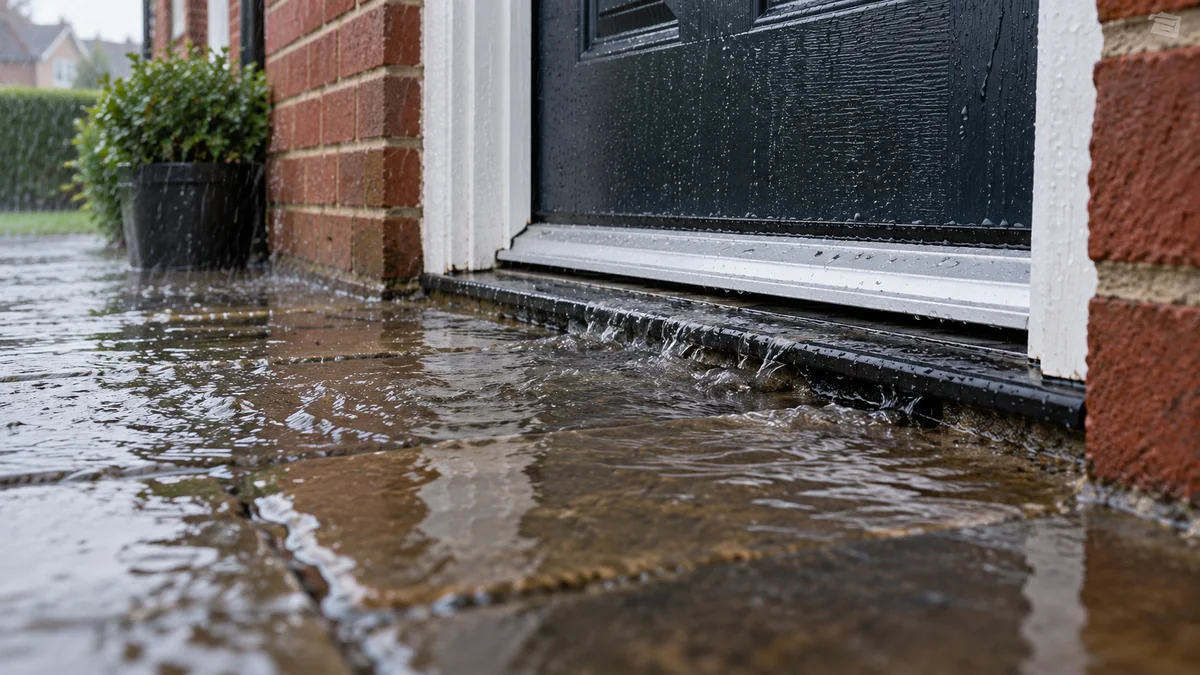
Start outside rather than blaming the door
Rainwater usually reaches the threshold because the external ground falls towards the doorway, water ponds against the wall, or a nearby drain or channel cannot cope.
A new door seal may reduce draughts, but it will not stop water that is being directed at the house in the first place.
Check levels, falls and hard landscaping
Look for paving that is level with the internal floor or which slopes back towards the entrance. Even a modest change in paving or driveway levels can make a big difference in a cloudburst.
If a previous patio or path has been relaid, ask whether the original threshold height and drainage arrangements were compromised.
Threshold details and upstands matter
Some doorways are more vulnerable than others. Low thresholds, worn seal details and limited upstand heights make it easier for water to bridge into the house.
That does not automatically mean the whole entrance needs replacing, but it does mean the details should be examined properly.
A channel drain is only useful if it can discharge
People often jump straight to the idea of a linear drain across the doorway. That can help, but only if there is somewhere suitable for the water to go.
A blocked outlet, a failed soakaway or a drain connected to an overloaded system may leave the channel drain acting like a shallow trough rather than a solution.
Temporary barriers and resilience measures have limits
A flood barrier or demountable board may help with relatively shallow water, but the rest of the building still needs suitable details. Water may simply find another route through airbricks, service penetrations or wall joints.
The more intense the flooding, the more important it becomes to think about the building as a whole rather than just the door.
Specify the repair around the cause
Good quotations should explain what is being altered and why: regrading paving, improving drainage, changing threshold details or adding suitable protection.
If the quotation only offers to replace the door, without addressing why water reaches it, the main problem may still remain.
What to photograph during the next downpour
If it is safe to do so, record the direction of the runoff before it reaches the step. A short video can show whether it is coming down the drive, spilling from an overflowing gully or running across a neighbour's paved area. Photograph the internal water line as well, including the point where the floor covering meets the frame. This gives a contractor a much better starting point than a description of a wet mat. Do not remain in rising water simply to collect evidence.
Once the rain has stopped, check whether the threshold sits below the external paving, whether the paving has sunk near a drainage channel and whether the channel has a proper outlet. These details can be measured and shown on a drawing, making quotations easier to compare.
A repair that can be tested
Ask for a proposal which states the existing levels, the intended new falls and the destination for intercepted water. A channel drain without a functioning outlet is not a solution. Where the problem affects a level-access entrance, the design must also preserve safe, practical access rather than merely creating a high step.
After the work, look for evidence that water flows away from the opening rather than collecting against it. If a barrier is recommended, ask who will deploy it, how quickly it can be fitted and what other low-level routes, including airbricks, have been considered.
When the issue may be beyond the doorway
Water that appears beneath an internal wall or floor can travel from some distance away. A defective service penetration, subfloor void or badly connected rainwater pipe may be the real entry point. Where dampness continues in dry weather, investigate plumbing leaks and residual moisture too. Do not assume every low-level damp patch is rain coming through the door.
If previous work has failed, ask the new contractor to explain specifically what the earlier repair did not address. That answer should appear in the written scope, not be left as a verbal assurance.
Official guidance and independent advice
Flooding can become dangerous quickly. Use official warnings and advice during an incident; this article is not a live risk assessment.
Prepare for flooding · Flood-proofing and recovery · National Flood Forum · Citizens Advice