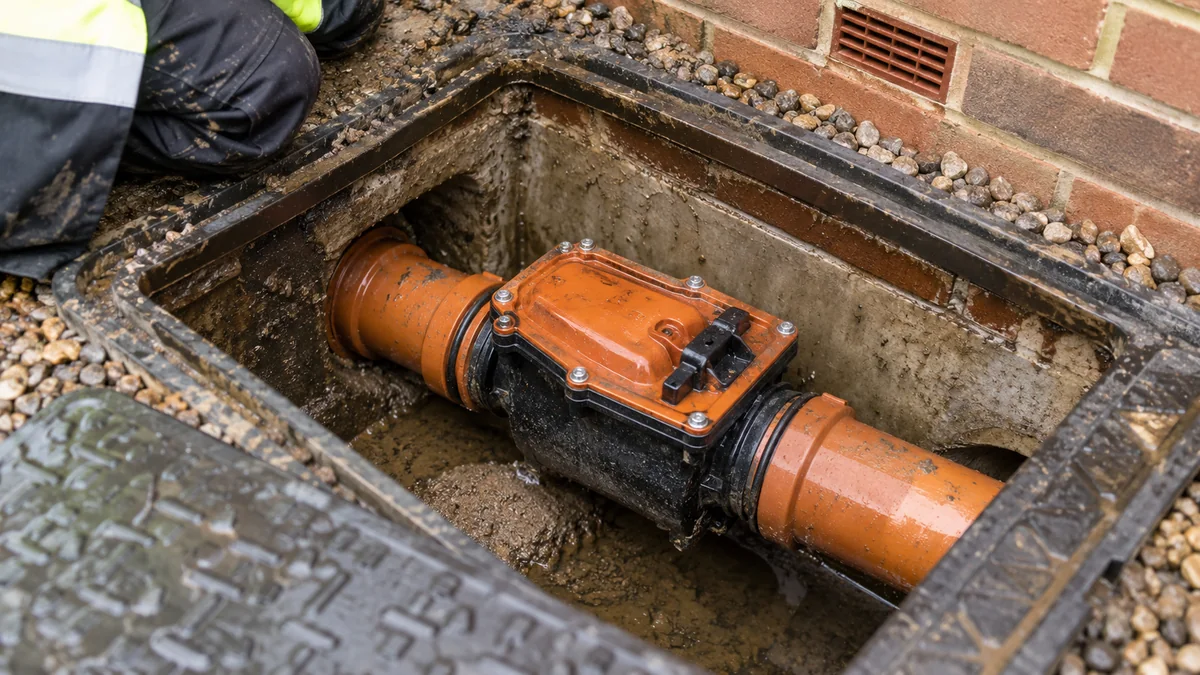
How backflow happens
Water in a surcharged sewer or drain may push back up a connected pipe. Low-level toilets, showers or floor gullies may be vulnerable if their outlets sit below the backing-up level.
What a valve does
A properly selected valve permits flow in the intended direction and closes against reverse flow. That sounds straightforward, but the entire drainage layout must be considered.
The important drawback
When the valve closes, water from your own sinks, toilets and appliances may have nowhere to go. Continuing to use them can cause flooding on your side of the valve.
It needs maintenance
Debris can prevent a valve sealing or cause it to jam. Access for inspection and cleaning should be built into the installation.
Whose pipe is it?
Ownership matters. Seek advice from the water company before modifying a shared or public sewer and use a qualified drainage contractor for private systems.
Questions to ask
Will the valve protect every relevant connection? What happens to wastewater while it is closed? How will it be maintained and tested?
Know what the valve can and cannot stop
A non-return valve is intended to reduce wastewater flowing backwards through a suitable drainage connection. It does not prevent river water entering a doorway or water rising through unrelated drainage routes. In some systems a closed valve also prevents wastewater from leaving the property, so using toilets or appliances during a surcharge may cause an internal overflow. Correct positioning depends on the drainage arrangement, ownership and access.
Ask about inspection and maintenance
A suitable drainage contractor should identify the affected branch, whether the pipe serves other properties and where the valve can be accessed and maintained. The device can become obstructed by debris and requires checking; it should not be buried where no one can reach it. Ask how the installation will be tested and who is responsible for servicing. If several appliances back up, or a shared sewer is involved, investigate the system first rather than buying a valve on the strength of an advertisement.
A valve is not a cure for every overflowing drain
A non-return valve is intended to reduce reverse flow in suitable pipework. It will not clear a blockage, increase the capacity of a public sewer or stop surface water entering through doors and walls. If the sewer is surcharged, a closed valve may also prevent wastewater from your own appliances escaping until the external water level falls. That matters especially where toilets, basins or washing machines are used during a storm. Owners need to understand this limitation before buying a device advertised as a simple flood solution.
The proposed location should be established from an accurate understanding of the drainage layout. An incorrectly placed valve might protect one appliance while leaving another connection exposed, or interfere with a shared run. A contractor should check which fixtures discharge through the pipe and whether there is safe access for future inspection.
Installation and upkeep
Wastewater carries solids, fats and other material that can stop a valve seating properly. A device that is never inspected may provide less protection than its owner assumes. Ask whether the selected unit is appropriate for the pipe size, contents and direction of flow, and how it will be cleaned. It should be accessible without destructive work, with the method and frequency of maintenance clearly explained. Do not open flooded drainage chambers or attempt to remove covers while sewage is backing up.
Where flooding has already occurred, a CCTV survey or other investigation may be needed to understand whether the source is a local blockage, a public sewer problem or another defect. The water company should be consulted about problems affecting its sewer network. Installing a valve does not transfer responsibility for a public sewer to the homeowner.
Questions to settle before paying
Ask the installer to put in writing which openings the valve is intended to protect, what happens when the outlet is surcharged, whether normal appliances can be used at that point and how the device will be tested. If several premises share drainage, clarify ownership and any permissions before alteration. A pump or other engineered arrangement may sometimes be more suitable, but that requires a proper design rather than guesswork.
Keep the manufacturer's instructions and a record of servicing. A valve can form part of a flood-protection plan, but it should never be treated as a substitute for recognising official warnings and staying clear of contaminated floodwater.
Reliable further information
For current warnings, official flood-risk maps and safety advice, use the relevant government service. This website cannot assess live conditions at your home.
Government flood guidance · National Flood Forum · Citizens Advice