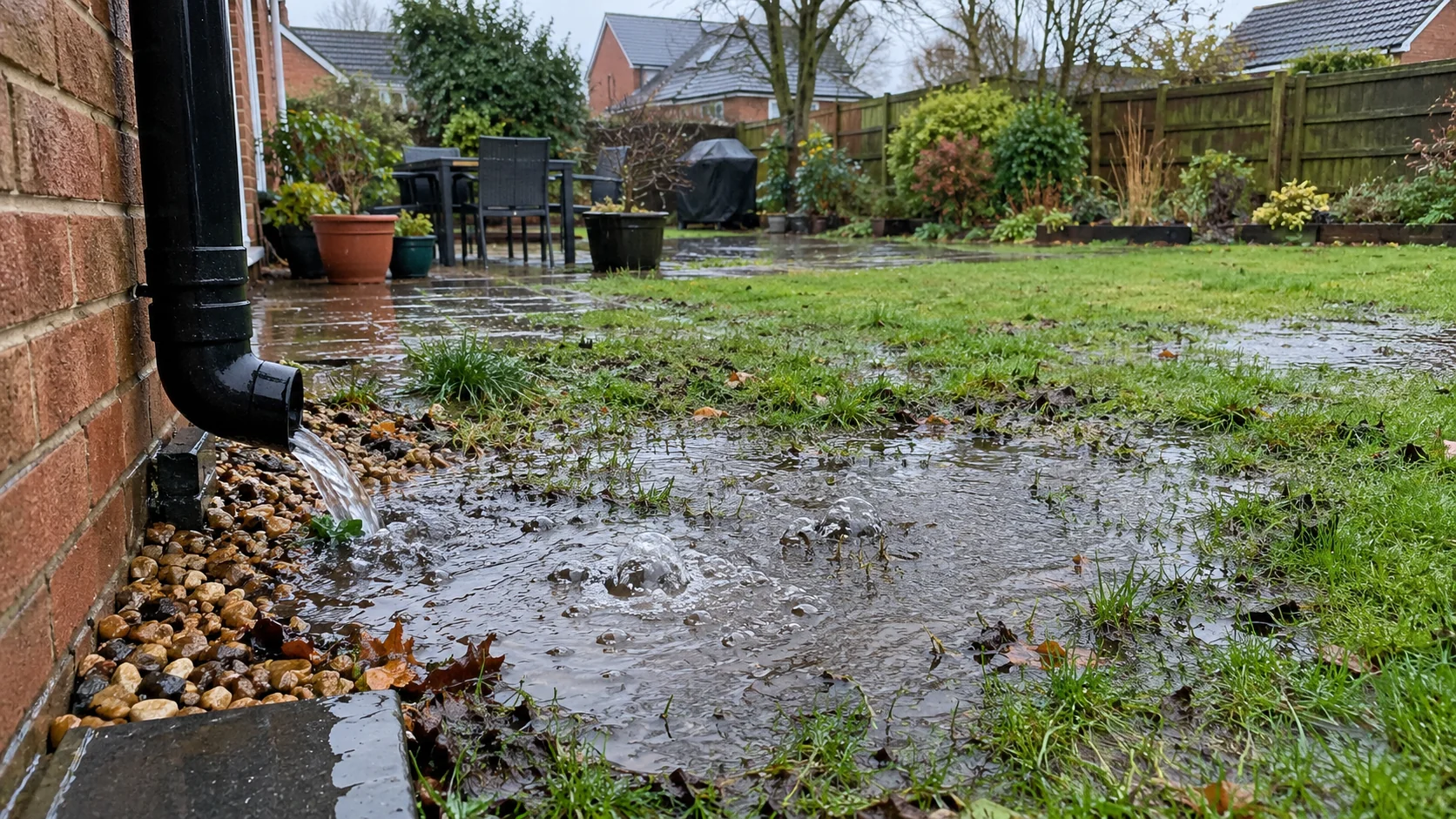
First identify what the soakaway serves
A soakaway lets suitable rainwater disperse into surrounding ground. It may receive water from a downpipe, a driveway or another surface-water collection system.
When the ground is already saturated, the water may not disperse quickly enough. An overflowing gully does not by itself prove that the soakaway is blocked.
A soakaway is intended to disperse collected water into suitable ground. It may overflow because the surrounding soil is already saturated, because sediment has reduced its capacity or because it was never large enough for the roof or paving connected to it. An overflowing inspection point is a useful clue but does not identify which problem is present. Keep a record of rainfall, the time the system takes to empty and whether neighbouring land also remains waterlogged.
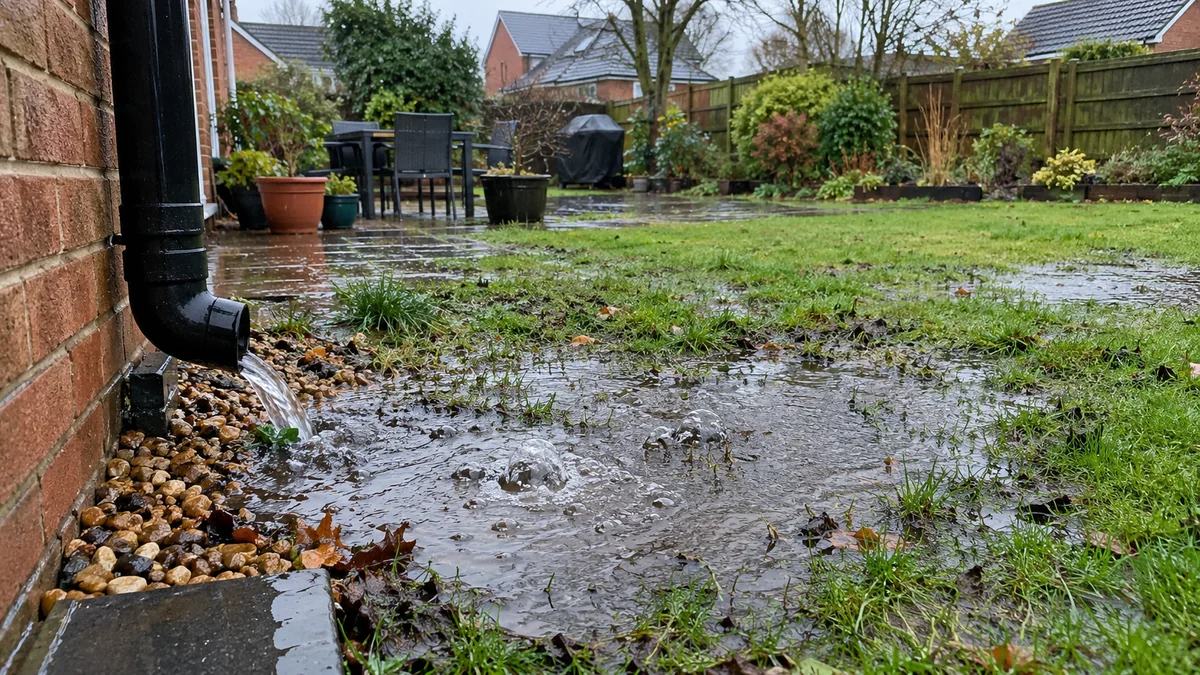
Soil and groundwater can limit performance
Clay-rich soil generally absorbs water more slowly than freely draining granular ground. A high water table also reduces the space available for incoming rainwater.
Design normally depends on ground investigation and infiltration testing. Simply digging a bigger hole without considering the site may create a recurring problem.
Replacing an old soakaway with a larger pit can be wasted money if the ground drains poorly. A contractor should consider ground conditions, infiltration testing where appropriate, the size of the contributing area and proximity to buildings and boundaries. Be cautious of anyone who proposes excavating close to foundations without examining the risks. Older houses may have shallow footings, and a failed excavation can create more problems than the original overflow.
Look for silt and damaged pipework
Debris from gutters and paved surfaces can enter the system over time. Access chambers, filters and upstream gullies may need clearing. Old pipework can also collapse or become obstructed.
If a contractor recommends excavation, ask what evidence shows the soakaway itself has failed rather than the pipe feeding it.
Ask what alternative discharge routes have been considered and whether permission is required. Rainwater connections should not be diverted into sewers or neighbouring land simply because those routes are convenient. The quotation should explain access for future maintenance and show where pipes connect. If a new system is installed, keep the layout and test records. They may be valuable if waterlogging reappears or a future owner needs to understand the arrangement.
Location is important
A poorly located soakaway can direct moisture towards foundations or neighbouring land. The appropriate distance depends on the site and applicable guidance; the commonly quoted distance from buildings is not a substitute for design.
Check whether there are basements, retaining walls, services, unstable ground or contamination issues before proposing a new location.
Do not divert the problem
Piping excess water to the boundary or public road is not automatically acceptable. Discharge into a public sewer may require permission.
A drainage designer or experienced contractor can assess legitimate options, including attenuation, rain gardens and other sustainable drainage systems.
What a useful survey includes
Expect a sketch showing roof or paved catchment areas, pipe routes, likely infiltration conditions, access points and proposed discharge.
A quotation that only says “new soakaway” without discussing ground suitability is not much use when the old one keeps failing.
Why ground conditions make a difference
A soakaway depends on the surrounding ground accepting water quickly enough. Heavy clay soils, an already-high groundwater level or a waterlogged site can make infiltration very slow, especially after several days of rain. In those circumstances, simply excavating a larger pit may not solve the underlying problem. The soil and the available space need to be assessed before the design is chosen.
Water collecting around the soakaway does not necessarily mean it has collapsed. The upstream pipe, silt traps and connected downpipes may be blocked. Establish whether water is reaching the soakaway and whether it can then leave the system.
Avoid creating a new problem
Discharging extra rainwater close to the house may increase saturation beside walls and shallow foundations. An unsuitable excavation could also disturb services or the support to neighbouring paths. Ask how the contractor has selected its distance from buildings and boundaries and whether the proposed arrangement complies with the rules that apply to the site.
If the property has been extended or paving added, the area draining into the existing soakaway may have increased substantially. A system designed for an older roof layout may no longer have sufficient capacity.
What a proper quotation should explain
A useful proposal will identify the connected catchment area, the route of the underground pipework, any investigation of infiltration conditions and the dimensions and type of the proposed installation. It should include access, disposal of excavated material and reinstatement of the garden or paving.
Do not pay for a soakaway described simply as a hole filled with rubble without understanding what is being built, where overflow will go and how future maintenance can be carried out.
Official guidance and independent advice
Flooding can become dangerous quickly. Use official warnings and advice during an incident; this article is not a live risk assessment.
Prepare for flooding · Flood-proofing and recovery · National Flood Forum · Citizens Advice