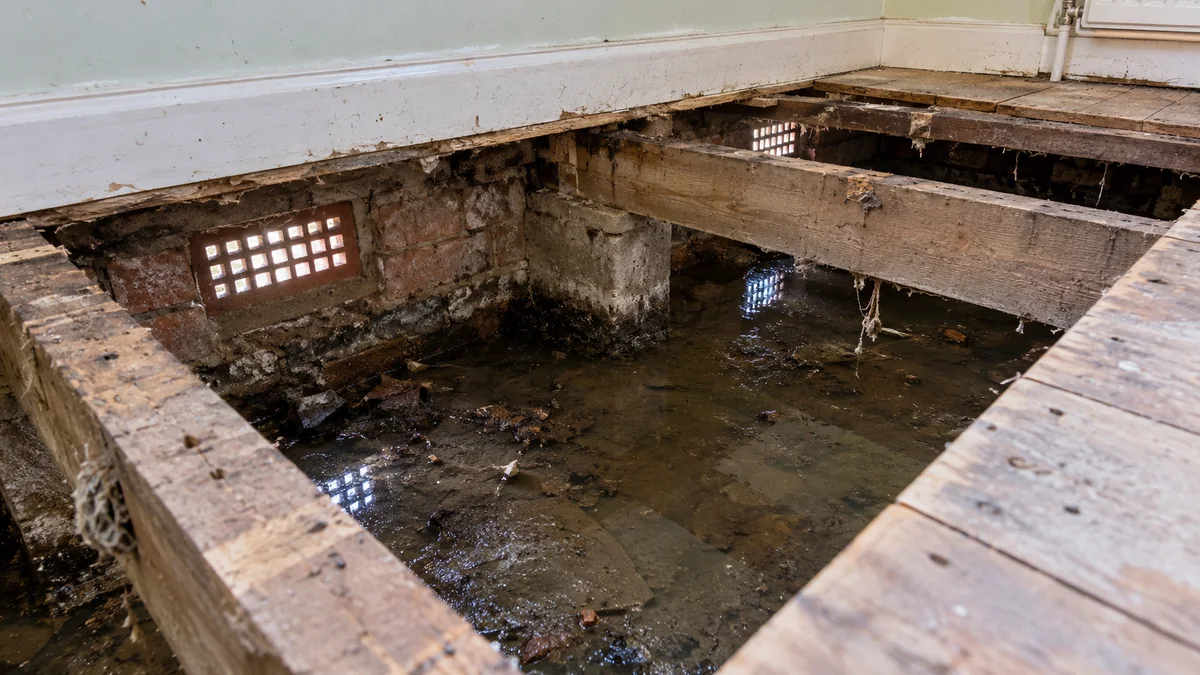
Deal with safety and electrics first
If water has entered a suspended floor void, start with safety. Electrical hazards, unstable boards, sewage contamination and concealed debris all need to be considered before anyone starts lifting floors.
In some cases the immediate priority is simply to make the area safe and document what has happened.
A suspended floor void is not an ordinary room that can simply be dried by opening a window. Water may remain beneath sleeper walls, trapped behind debris or at the bases of loadbearing masonry. If contaminated floodwater has entered the void, there may also be biological hazards. The inspection plan should explain how access will be achieved safely, which services pass through the space and what condition would justify lifting further boards. Photograph the structure before covering it again: the next owner or insurer may need to know what was examined.
Decide what really needs to be opened up
A competent inspection does not necessarily mean lifting every board in the room. The aim is to open enough of the floor to see what has happened beneath, without causing needless damage.
That may involve targeted lifting near the point of entry, the wettest area or the most vulnerable structural details.
Timber strength should be assessed by its actual condition, particularly at bearings, not by the colour of the wood. Flooding can leave staining without decay; equally, long-standing leaks and poor ventilation can cause deterioration that predates the flood. Ask for a record of wet and apparently unaffected areas so that replacement is limited to defective members. Where a structural engineer is needed, the report should say why. A blanket recommendation to replace every joist is not a satisfactory substitute for inspection.
Inspect joist ends, sleeper walls and subfloor vents
The critical areas are often where joists bear into walls, where sleeper walls interrupt the void and where ventilation openings may have admitted water or become blocked.
A room can appear to be drying while concealed timber and wall bases remain wet.
Drying equipment is often installed in the rooms above, but air movement below the boards may be poor. Contractors should explain how the void will be ventilated or dried and how progress will be checked. Simply sealing airbricks to keep future floodwater out can create a new condensation problem in a timber floor. Any flood-resistant vent detail should be designed to preserve required ventilation while managing the risk of water entry. Do not close the floor based only on a dry-looking surface.
Moisture readings need context
Meters are helpful, but they do not interpret the building for you. Different timber sections dry at different rates, and high readings must be considered alongside visible staining, airflow and the history of the incident.
That is why a proper inspection report is more useful than a single unexplained reading.
Drying, cleaning and ventilation must work together
Depending on the contamination and flood depth, the floor void may need cleaning, pumping, improved airflow and monitored drying before repairs are closed up.
Blocking vents or sealing everything up too soon can trap moisture and prolong the problem.
Repair should follow diagnosis
Some floors need local timber repairs. Others need much more limited work than the owner first feared. The right answer depends on the condition of the joists, boards and supports, not on a blanket assumption that everything flooded must be replaced.
Ask contractors how they decided the scope, not just how quickly they can start.
Get useful evidence from the inspection
A written record should identify which boards were lifted, the condition of the timber at its bearings, any silt or contamination found and whether ventilation routes remain clear. Photographs of concealed areas are particularly important because nobody can check them after the floor has been closed.
Ask the inspector to separate observed defects from possible future risks. Wet timber is not automatically rotten, and a single elevated meter reading does not prove structural failure.
Avoid an unnecessarily large strip-out
The extent of opening-up should follow what is discovered. If the void is accessible and the structural timber is sound, carefully targeted work may be enough. Widespread replacement may be warranted where there is serious contamination or real structural damage, but the reason should be recorded.
Where joists enter masonry, it can be useful to assess local conditions rather than assume the whole floor is equally affected.
Set conditions for closing the floor
Before reinstatement, establish what cleaning and drying has been completed and whether water is still entering after rainfall. A contractor should explain how they will decide that the void has recovered sufficiently and who takes responsibility for the final sign-off.
Leave access to relevant services and ventilation arrangements as designed. Sealing the void simply to hide lingering smells risks making the underlying moisture problem harder to discover.
Official guidance and independent advice
Flooding can become dangerous quickly. Use official warnings and advice during an incident; this article is not a live risk assessment.
Prepare for flooding · Flood-proofing and recovery · National Flood Forum · Citizens Advice